Actor Headshots vs. Performer Headshots: What’s the Difference?
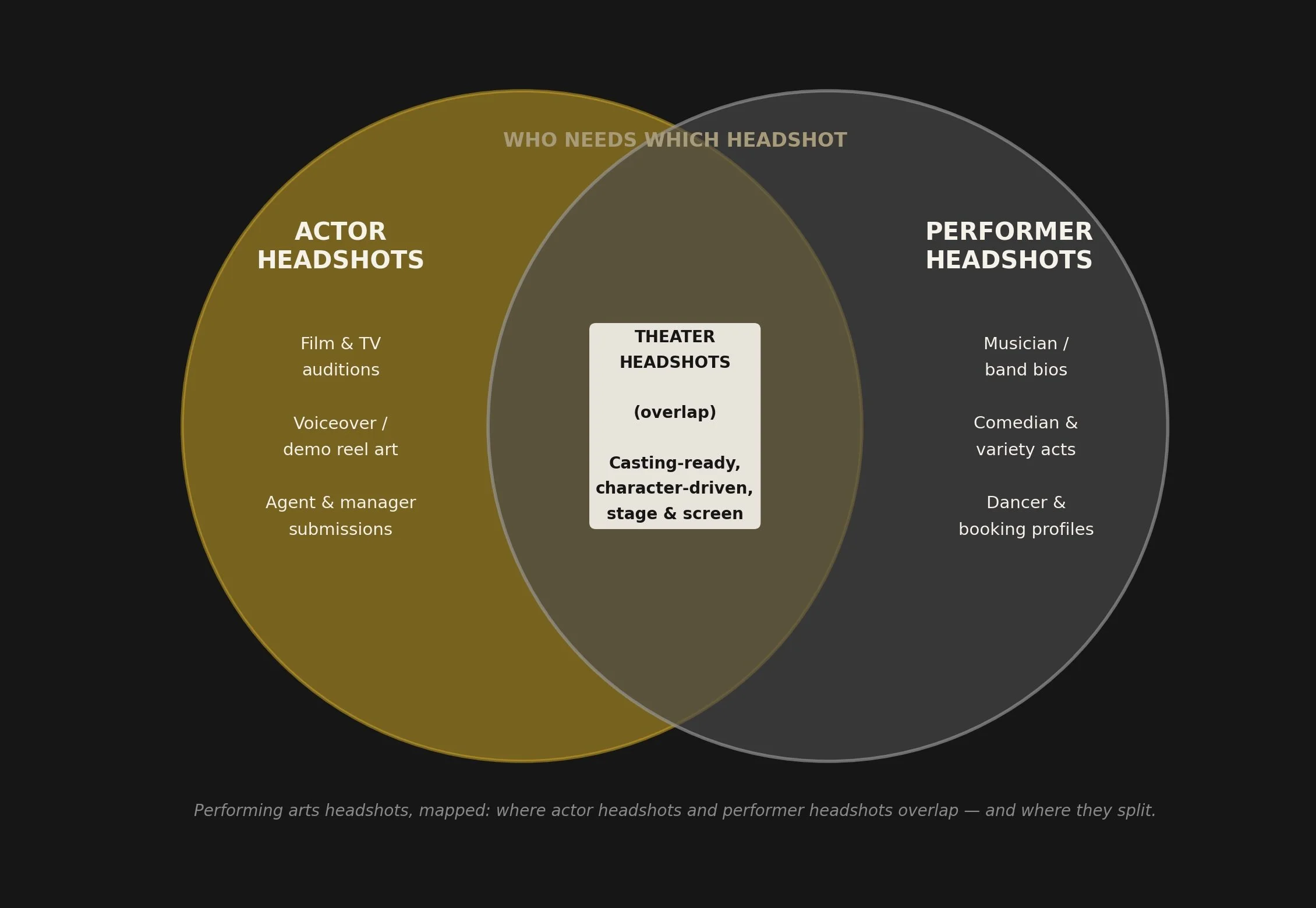
If you've been searching for headshots in Denver, you've probably noticed the terms get used almost interchangeably — actor headshots, performer headshots, theater headshots, headshots for actors. Google treats them like synonyms. Casting directors, bookers, and venues don't always agree.
Here's the honest answer: the two overlap a lot, but they're not identical. Knowing the difference can save you from showing up with the wrong image for the room you're trying to get into — a casting director, a club booker, a venue, or a fan scrolling your bio page are all making fast, visual judgments, and the photo that works for one won't necessarily work for another.
What are actor headshots?
Actor headshots are the industry-standard term for images submitted to casting directors, agents, and managers for film, TV, theater, and commercial work. They follow a fairly specific set of expectations: naturalistic expression, minimal retouching, and a clear sense of "type" — the roles a casting director could believably cast you in the moment they see the image. That's the same reason casting doesn't cast people, it casts types — your headshot is doing pattern-matching work before you ever walk into the room.
An actor headshot isn't trying to look flattering. It's trying to look castable. That's why a strong session usually includes multiple looks — a dramatic look, a commercial look, maybe a corporate or "authority" look — rather than one all-purpose photo. Casting directors are pattern-matching against a role in front of them, and the more clearly your headshot communicates a type, the faster you get considered for the right auditions.
There's also a technical layer actors deal with that most performers don't: submission platforms like Actors Access and Casting Networks have specific file size and crop requirements, and getting this wrong can get a great photo rejected on a technicality.
What are performer headshots?
"Performer" is the broader umbrella. It covers actors, but it also covers musicians, comedians, dancers, drag and variety performers, and other stage talent who need a professional photo for a bio page, EPK, program, or booking site — not a casting submission. Sites like Backstage reflect this directly, listing opportunities for actors, models, and creative talent side by side.
The visual goals shift here too. Instead of neutral, character-driven stillness, performer headshots often lean into energy, personality, and stage presence — a knowing smirk for a comedian, mood and lighting that matches the sound for a musician, a hint of movement for a dancer, or a persona-driven look for a drag or variety act.
None of that is "wrong" by actor headshot standards — it's just answering a different question. An actor headshot asks, "Can I believe this person in a role?" A performer headshot asks, "Does this person's energy make me want to book them, watch them, or listen to them?"
So if you're a performer who isn't specifically pursuing film, TV, or theater casting, "actor headshot" might not be the right search term — even though the photography process looks almost identical from the outside, and even though the same photographer can usually shoot both well.
Where the two overlap: theater headshots
Theater headshots sit right in the middle. Stage actors need the casting-ready, character-driven qualities of a traditional actor headshot, but they're also performers in the truest sense — working in front of a live audience, often building a public-facing bio or program presence the way a musician or comedian would. Many union stage actors, including SAG-AFTRA members working in theatrical contracts, end up needing both a casting-standard headshot and a more expressive one for programs and marketing.
This is the clearest example of why the line between "actor" and "performer" blurs: the same session, the same photographer, and often the same final image can serve both purposes.
A few real-world examples
A musician building an EPK or personal brand doesn't need a "casting-ready" neutral expression — they need an image that instantly communicates genre and mood. A folk artist's headshot should feel different from a metal band's promo photo, even shot in the same studio.
A comedian submitting to a club or festival needs a photo that reads as funny, sharp, or distinctive at thumbnail size, since most bookers are scanning a grid of lineup photos, not a full submission packet.
A dancer promoting a showcase often wants a headshot that hints at posture, line, and physical control — closer to a hybrid of a headshot and a movement photo.
In every case, the underlying skill is the same — a photographer who can direct a real, un-posed moment out of someone. What changes is the target: a casting director's database versus a booker's inbox versus an audience scrolling social media.
Key differences at a glance
Actor headshots
- For film, TV, theater & commercial casting
- Judged by casting directors and agents
- Built around specific character types
- Naturalistic, unposed expression
- Neutral, character-driven wardrobe
- Often multiple looks per session
- Formatted for Actors Access and casting databases
Performer headshots
- For musicians, comedians, dancers & variety acts
- Judged by bookers, venues, and audiences
- Built around stage presence and personality
- More expressive, energy-forward expression
- Wardrobe reflects the act, genre, or brand
- Often a single strong hero shot
- Formatted for bios, EPKs, and booking profiles
Which one do you actually need?
Ask what the image needs to do, and for whom.
If you're submitting to casting directors for film, TV, or theater, you need actor headshots — full stop. Casting databases expect a specific look, and a more stylized "performer" image will read as off-brand in that context.
If you're a musician, comedian, dancer, or other performing artist building a bio, press kit, or booking profile, a performer headshot gives you more room to show personality and match the tone of your act — without needing to hit the neutral, casting-specific marks an actor headshot requires.
If you work in theater, plan for both. Many working stage actors keep a casting-ready headshot for submissions and a slightly more expressive shot for programs, marketing, and their own site or socials. If you're prepping for a session, our guide on what to wear for your actor headshot session is a good place to start.
Still not sure? A quick gut check: if the first person to see your photo is a casting director deciding whether to bring you in for an audition, get actor headshots. If it's a fan, a venue booker, or someone scrolling your bio page, get performer headshots. If you genuinely can't tell — common for theater actors and hybrid artists — book a session built around character range and ask for at least one look from each camp.
A note on searching for the right photographer
Whether you land on "actor headshots," "performer headshots," "performing arts headshots," or "headshots for actors," you're generally looking for the same thing: a photographer who understands what the person on the other end is actually scanning for. The label matters less than whether your photographer knows how to shoot for that specific audience.
At Draper Studios, sessions are built around real character types and real stage presence, not a one-size-fits-all pose. Whether you're an actor prepping for casting submissions or a musician, comedian, or dancer who needs a headshot that matches your act, it starts the same way: figuring out exactly who the photo needs to convince.
Ready to book your Denver headshot session?
Draper Studios offers actor and performer headshots in Denver for film, TV, theater, music, comedy, and dance — with sessions built around who you are on stage or on camera, not a generic template. For a full walkthrough before you arrive, check our guide on how to prepare for your headshot session.