"I'm Not Photogenic." Why You Hate Photos of Yourself (and What Actually Fixes It)
"Just so you know, I'm not photogenic."
I hear some version of that sentence at the start of almost every professional headshot session. Usually in the first two minutes. Usually said like an apology.
It's the most common thing people tell me, and it's almost never true. What's true is that they've been photographed badly, more than once, and reached a reasonable conclusion from the evidence.
The evidence is real. The conclusion is wrong. Here's what is actually going on, and what fixes it.
Photogenic isn't a trait
People talk about being photogenic the way they talk about being tall. Something you have or you don't.
It doesn't work like that. A photograph of a person is the result of a few things happening at once: where the light is, where the camera is, what the body is doing, and what the person is thinking in the fraction of a second the shutter opens. Change any one of those and you get a different face.
When someone says they photograph badly, what they mean is that nobody has been managing those things for them. They were left to do it themselves, without being told that was the job.
Three reasons you don't like photos of yourself
1. You've never seen your own face the right way round
The face you know is the one in the mirror, and the mirror flips it. No face is symmetrical, so the version in a photograph is slightly, persistently unfamiliar: the part is on the other side, the eyebrow that sits higher has switched places.
Psychologists call the underlying effect mere exposure. We prefer what we've seen most. Everyone else has only ever seen the un-flipped you, and to them the photograph looks normal. You are the one person it looks wrong to.
2. Your face is built to move
In person, nobody sees you as a still frame. They see expression arriving and leaving. A photograph takes one slice out of that, and most slices are in-between moments: half a blink, the start of a word, a smile on its way out.
A casual snapshot is one slice chosen at random. That isn't a fair sample, and it isn't what you look like.
3. The camera face
This is the big one. The moment a lens points at most adults, something happens. The shoulders come up. The breath stops. The jaw sets. And a smile appears that has been used for every photograph since the fourth grade.
That smile is held with the mouth. The eyes don't join in. Viewers can't always say what's off, but they read it instantly as a person enduring a photo.
You aren't bad at being photographed. You're doing two jobs at once: being the subject, and directing the subject.
Why "just relax" never works
The standard fix is an instruction. Relax. Be natural. Give me a real smile.
None of those can be followed. You can't relax on command any more than you can fall asleep on command, and trying makes it worse, because now you're monitoring yourself. "Look confident" produces a person concentrating on looking confident. It photographs exactly like that.
I spent fifteen years in Los Angeles coaching and directing actors before I photographed people for a living, and this is the first thing that work teaches you. You never ask an actor for a result. You don't say "be sad" or "look confident." You give them something to do or something to think, and the expression takes care of itself.
The same thing is true for an attorney, a founder, or a nurse practitioner who would rather be anywhere else. Expression follows thought. So the job isn't to arrange your face. The job is to give you something real to think about and be ready when it lands.
What people are usually told
- "Relax."
- "Big smile."
- "Look natural."
- "Chin down. No, up. Hold that."
What direction sounds like
- A specific thought, not a specific face.
- One small physical change at a time.
- Conversation that keeps going while the camera works.
- Somebody else watching the details so you don't have to.
What a directed session changes
Nothing here is a trick. It's just a different division of labor.
The first frames don't count. Nobody is at their best in the first few minutes, and I don't expect it. Those frames are for settling in. Some people need room for that, and they get it.
You're never left guessing. Posture, angle, expression, what to do with your hands: I'll tell you. You don't need to know how to pose.
The room isn't silent. There's music, for the same reason film sets used it a hundred years ago. I wrote about that in What Hollywood Figured Out 100 Years Ago.
It's private. One studio, no audience, nobody waiting behind you for their turn.
You choose. You get a private proof gallery the same day, and the finished image is the one you pick, not the one I decide you should live with.
The goal isn't to make you look like someone else. It's a photograph that looks like you on a good day, which is the version the people who know you already see.
Five things that help before you come in
- Don't rehearse a smile in the mirror. It trains the camera face, and it trains it backwards.
- Wear something you already wear. New clothes make people stiff. If you're unsure, I've written a full guide on what to wear for a portrait session.
- Don't arrive straight from a sprint. Ten minutes of margin does more for your face than any amount of prep.
- Tell me what you've hated. "My smile looks forced." "One eye looks smaller." "I always look angry." That's useful information, not vanity. It tells me what to watch for.
- Let go of the result. Your part is to show up. Getting the photograph is my part.
Questions people ask
Can a person really be unphotogenic?
Not in the way people mean it. Some faces are more forgiving of bad light and a bad angle, which is why some people look fine in snapshots. With the light, the angle and the direction handled, that difference mostly disappears.
What if I hate my smile?
Then we don't build the session around a smile. Plenty of strong professional headshots are a closed mouth with something going on behind the eyes. Often the smile people hate is the held one, and the real one turns out to be fine once it shows up on its own.
Do I need to practice poses?
No. Practiced poses read as practiced. Direction happens in the room, one adjustment at a time.
I've had a professional headshot before and didn't like it. Why would this be different?
A lot of headshot sessions are built for volume: stand here, three frames, next. That works for people who are already comfortable. If you aren't, you need someone directing the session rather than operating the camera. That's the part I do.
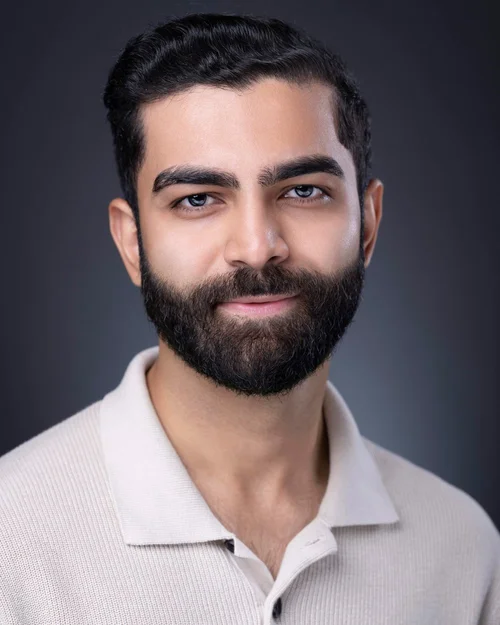
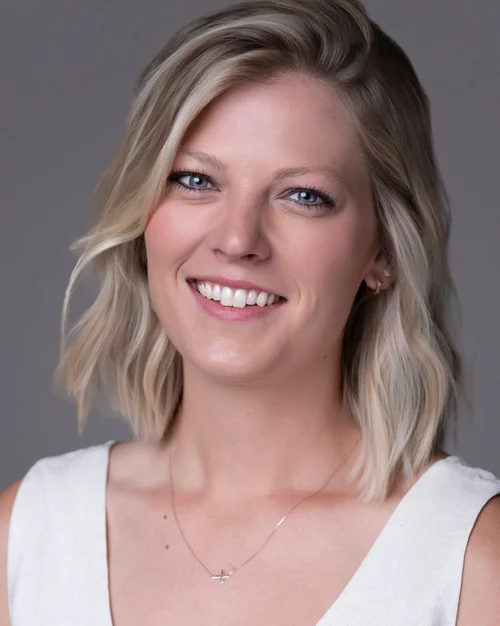
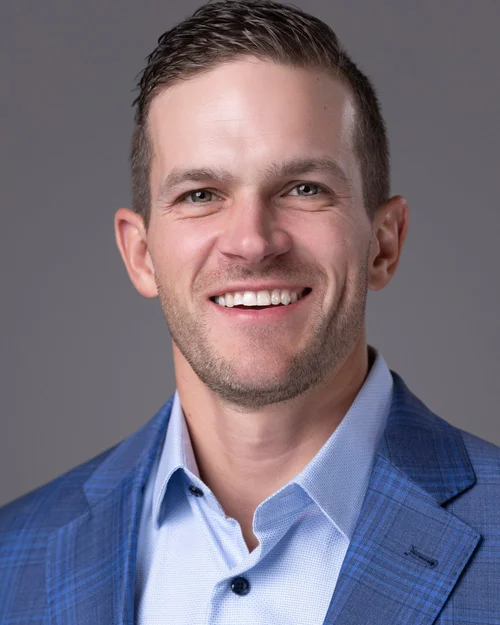

Most people who book with me don't like having their photo taken. That's normal, and it's not a reason to keep using the photo from six years ago.
If you want to see what a directed session looks like, the work and current rates are on the Denver headshots page. And if you don't love what we get, we shoot again. Or send me a note and tell me what you've hated about past photos. That's a good place to start.